
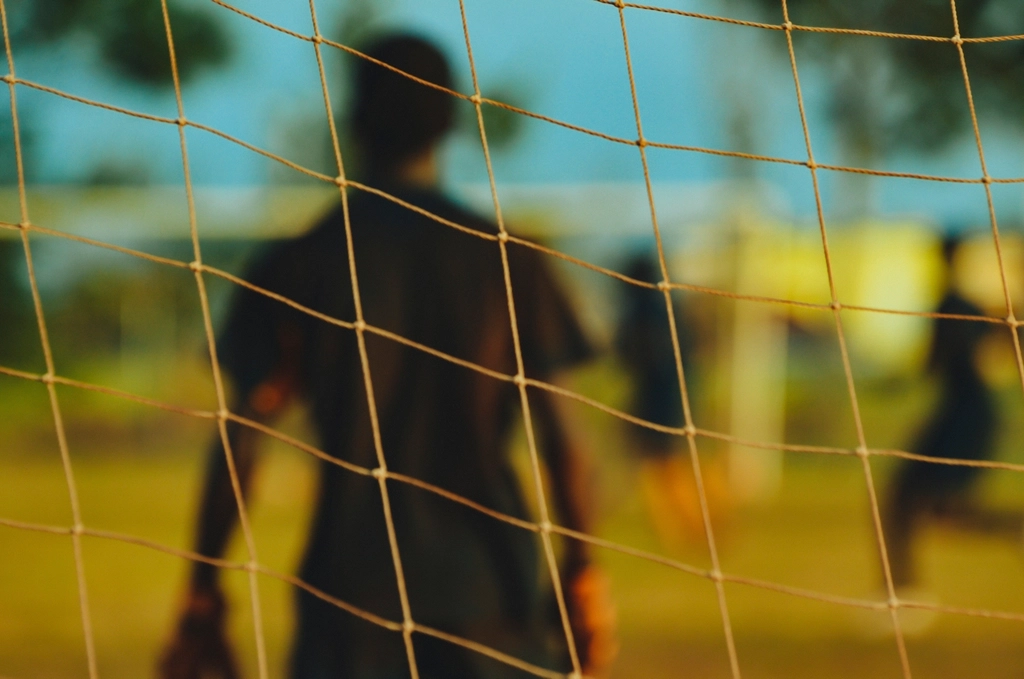
The position nobody volunteers for
In almost every adult recreational session there is a familiar three-minute ritual before kick-off in which everybody looks at their boots and nobody goes in goal. Eventually someone sighs, pulls on the gloves, and spends the next hour being cold, bored and then briefly blamed. It is one of the odder features of amateur football that the position which most changes how you understand the game is treated as a punishment.
This piece makes a modest suggestion: spend a week in goal, deliberately. Not as a favour to the group, and not permanently, but as a piece of training for your outfield game and as a genuinely different physical stimulus. It is a fortnight’s worth of insight compressed into a few sessions, and most players come out of it with a better understanding of space, timing and their own body than any drill would have given them. As ever, this is general information rather than medical advice; fingers, wrists and heads deserve caution, and anything that keeps hurting deserves a professional opinion.
Why the position teaches you so much
An outfield player sees the game from inside it. A goalkeeper sees it from outside, facing the whole pitch, with two or three seconds more warning than anybody else. That single change of viewpoint is the reason keepers are often the best readers of a game and the reason a week between the posts tends to improve the way you play everywhere else.
- You see patterns, not events. From the edge of the six-yard box you watch attacks form. You start to notice which runs actually cause problems and which merely look busy, and that knowledge transfers directly to how you defend and attack.
- You learn what a bad pass looks like from behind. Every square ball across your own third is terrifying from the goalkeeper’s viewpoint. Players who have kept goal stop playing them.
- You discover the value of communication. The keeper is the only person who can see everything and is expected to say so. A week of doing that makes most players noticeably more vocal afterwards.
- You experience pressure honestly. One error, immediately visible, with no chance to make up for it in the next phase. It is uncomfortable and it recalibrates how harshly you judge others.
The physical demands are different, not lighter
The common assumption is that goalkeeping is the easy option for the unfit. Anyone who has done a full session in goal after years outfield knows better by the following morning. The total distance covered is small, but the nature of the work is unusual and touches tissue that outfield football rarely loads.
Hips, groin and the lateral world
Football played outfield is overwhelmingly forwards and backwards. Goalkeeping is sideways. Shuffling along the line, pushing off one leg to dive, recovering to a set position and repeating it produces significant demand through the adductors, the hip rotators and the glutes. This is exactly the tissue that recreational players tend to neglect, which is why a week in goal often produces a very specific kind of soreness on the inside of the thighs.
Hands, wrists and upper body
The other surprise is upper-body fatigue. Catching a firmly struck ball is a genuine impact absorbed through the fingers, wrists and shoulders, and getting up off the floor thirty times an hour is a full-body movement most adults have not practised since childhood. If you have never done it, the getting up will tire you more than the diving.
The non-negotiables before you start
Goalkeeping is safe when a few basics are in place and genuinely risky when they are not. These are the things worth insisting on even in a casual session.
- Wear gloves. Not for style. They protect fingertips from the sort of hyperextension that produces a sprain lasting a month, and they make catching easier, which reduces the number of awkward saves you attempt.
- Check the goal and the ground. Portable goals must be anchored. Look for stones, ruts and hard patches in the goalmouth before you commit to diving into them.
- Warm the shoulders and hips. Arm circles, gentle rotations, a few side shuffles and half a dozen soft dives from your knees before anyone shoots at you.
- Learn to land, before you learn to dive. Start on your knees, land on your side rather than your elbow or your hip bone, and keep the ball out in front of you. Ten minutes on this is worth more than any amount of shot-stopping.
- Treat head contact seriously. Collisions happen in crowded goalmouths. If anyone takes a blow to the head and feels off, the session is over for them, without debate.
The set position and how to move
Almost all of amateur goalkeeping is decided before the shot is struck. If you are moving forwards, backwards or sideways at the moment of contact, you cannot push off effectively in either direction, and the shot goes past you with no dive attempted. The set position is simply the moment of stillness that lets you go either way.
Stand with your feet a little wider than your shoulders, weight on the balls of your feet, knees softly bent, hands up somewhere around waist height with palms forward. The most common amateur error is standing upright with hands by the sides, which adds a fraction of a second to every save and turns a reachable shot into a goal. Get set as the shooter looks down at the ball, and stay set until the ball is struck.
Movement between saves should be a shuffle rather than a run, keeping your feet under you and your shoulders square to the ball. Crossing your feet is fine for covering distance but leaves you unable to react, so finish every movement with a small stop and a re-set.
Handling, and knowing when not to catch
Beginners try to catch everything, which is how balls end up in the net off a keeper’s chest. Experienced keepers make a fast decision about which of three outcomes they are aiming for.
- Catch when the ball is comfortable. Hands together behind the ball, thumbs close for shots at chest height and above, little fingers close for anything below the waist. Absorb by letting the hands travel back with the ball rather than meeting it rigidly.
- Parry wide when the shot is hard or awkward. Push the ball towards the corner flag, never back into the middle. A save that produces a corner is a completely successful save.
- Smother when a striker is through. Get out early, get low, make yourself wide and take the ball or the space. Waiting on the line against a one-on-one is the worst of both options.
- Use your feet without shame. At close range there is no time for hands. A blocked shot off a shin counts exactly the same as a fingertip save.
The part of the job that is not about saving
Modern goalkeeping is at least half a footballing role, and this is the part that most rewards an outfield player who has wandered into the position. You already know how to receive a pass, open your body and pick a forward option. That skill is unusual among casual keepers and it makes your team measurably better at building out from the back.
Two habits matter more than any technique. The first is starting position: standing a few metres off your line when play is at the other end, so you can sweep up long balls in behind rather than watching them bounce. The second is talking — telling the defender in front of you whether they have time, which side to show an attacker, and when you are coming for the ball. Say it early and say it loudly enough to be useful, then commit to what you said.
How to run a keeper week in a casual group
The best version of this is structured rather than sacrificial. Agree that for one week everybody takes a spell in goal, in rotation, for a fixed period rather than for whoever loses the argument.
- Rotate every ten or fifteen minutes. Short spells keep people warm, keep the standard reasonable and mean nobody spends an hour freezing.
- Warm the keeper up properly each time. Six soft shots at a new keeper before anyone hits one hard. This is a courtesy and an injury-prevention measure at the same time.
- Give the keeper a job in the game. Rules like “the keeper must be involved in every restart” turn the position into part of the play rather than a waiting room.
- Adjust the shooting. Placement over power in a mixed group. Nobody in a recreational session needs to strike a ball at full force from eight metres.
- Talk about it afterwards. Ask people what they noticed from back there. The answers are usually the most useful tactical conversation the group has all season.
A week between the posts will not make you a goalkeeper, and it is not supposed to. What it does is give you a different view of your own game, load your hips and shoulders in a way that ordinary football does not, and permanently change how you treat whoever is in goal next week. For a leisure player chasing variety and general fitness rather than a trophy, that is a very good return on seven days.