
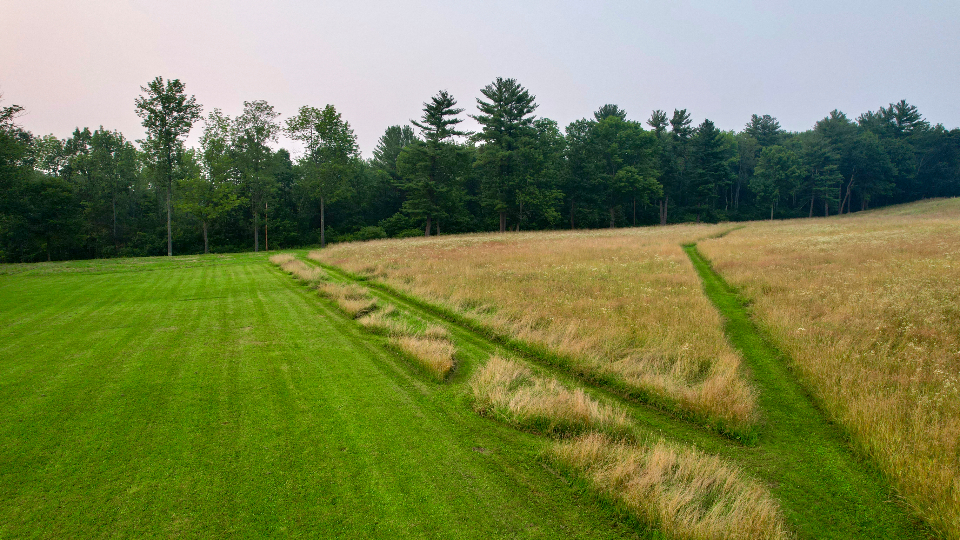
A pitch is a crop, not a carpet
The first useful shift in thinking is to stop treating the pitch as a surface and start treating it as a living thing you are farming badly. Grass is a plant. It grows, it compacts, it runs out of air at the roots, and it dies where you walk most. Nobody at an amateur club has a groundsman, a budget or a tractor. What most of us have is a strimmer, some forks, four people who turn up, and a landowner who answers emails when it suits.
You are not going to produce a professional surface. What you can do is keep a pitch playable and safe for a season, slow the rate at which it degrades, and show whoever owns it that the club is a decent tenant. Those three are achievable with volunteer labour. Anything beyond them needs machinery you will have to hire.
What the grass actually needs across a year
The end of the season is the real start
The most valuable work happens in April and May, when nobody wants to do it because the football has finished. This is when you can decompact, fill in the worst of the damage, seed and let it establish while the ground is warm and there is still rain about. A pitch renovated in May recovers by August. A pitch left until August does not recover at all; it just goes into the season with last year’s scars.
Summer is about growth and height
Through the summer the job is mowing regularly and not too short. Cutting low looks tidy and is a mistake: short grass has short roots, and short roots cannot survive a wet November. Most amateur pitches want cutting a good deal higher than instinct suggests. Take a little off often rather than a lot occasionally.
Autumn and winter are damage control
Once fixtures start, growth slows and stops, so anything you wear off will not grow back until spring. From October onwards the work is about spreading the damage rather than repairing it: moving training areas, using different corners for warm-ups, forking wet ground so it drains rather than smearing.
Drainage, which you cannot mow your way out of
If your pitch holds water, nothing else you do matters much. Waterlogged ground gets compacted faster, tears more easily, and takes longer to recover, and it is the single biggest cause of lost fixtures at amateur level.
Proper drainage — laterals, gravel bands, a piped system — is a contractor job with a real invoice. Volunteers cannot install it and should not try. What volunteers can do is help water get off the surface and into whatever drainage exists.
- Spiking and forking help more than they look like they should. Putting holes in the top few inches breaks the compacted cap that stops water getting down. A garden fork works. Doing it when the ground is soft but not saturated works best.
- Find out what is already under there. Older council pitches often have a drainage system that was installed decades ago and then forgotten. Sometimes the outfalls are simply blocked. Clearing a ditch has rescued more pitches than any amount of forking.
- Watch where the water actually goes. Walk the pitch during heavy rain once, on purpose. Fifteen minutes in a coat tells you more about low spots and flow than a year of guessing.
- Do not roll a wet pitch to flatten it. It feels productive and it compacts the ground further, which makes the drainage worse for years. Rolling has a place, and that place is a narrow window in spring.
Goalmouths, and the other places that die first
Wear is not spread evenly. Goalmouths, the centre circle and the strip in front of the dugouts take a disproportionate share, because that is where players stand, turn and scuff.
The realistic responses are unglamorous. Move the goals if the pitch markings allow it, even by a few metres, so the goalmouths are not in the same place every season. Keep warm-ups and shooting drills off the goalmouth entirely — warming a keeper up in the goal you are about to play in destroys it twice as fast. Divot up after every match: five minutes with the whole squad treading back kicked-out turf is genuinely effective and costs nothing. And when a goalmouth has gone to mud, seeding it in October is wasted, because nothing germinates in cold ground. Note it, live with it, fix it in May.
What volunteers can realistically do
- Divot repair after every game. The cheapest, highest-return job there is. Make it part of the routine before anyone goes to the clubhouse, not an optional extra.
- Litter and debris walk before kick-off. Broken glass, dog mess and stones are a safety issue on a public pitch, and a five-minute sweep is the difference between an inconvenience and an injury.
- Regular mowing at a sensible height. If you can only own one job, own this one. Height and consistency matter far more than stripes.
- Forking the wet corners after heavy rain. Not the whole pitch. Just the areas that sit wet, and only when someone has half an hour spare.
- One organised work day in May. Scarify, seed, top-dress the worst areas, sort the nets and posts. Get a dozen people for a morning rather than two people for a month.
- Photograph everything. Dated photos of the surface are your evidence when you ask the council for work, and your record of whether anything you tried made a difference.
When a game should be called off
Somebody has to make this call, usually early on a Saturday, in the dark, while a group chat asks whether it is on. Two separate questions are involved and they get muddled.
The first is safety. Standing water deep enough to stop a ball, ground frozen hard, ice, hidden holes, an unsafe goal frame: these are not judgement calls. If it is unsafe, it is off, whatever it costs in fixture congestion. Frozen ground in particular is worth taking seriously, because a rutted surface that has frozen solid is genuinely dangerous to land on.
The second is the pitch. A game played on a saturated surface can undo a season of work in ninety minutes, and that damage is not visible until spring. This is a harder conversation, because a referee may pass the pitch as playable while a groundsman would call it off. If the club has any say, err towards protecting the surface early in the season and accept more damage late on, when there is less season left to protect. Whichever way you go, decide early and tell people early. Nobody minds a call-off; they mind driving forty minutes to find out.
Dealing with a council or a landowner
Most amateur clubs do not own their pitch. You rent it from a council, a school, a farmer or a parish trust, and the relationship matters as much as the maintenance.
A few things consistently help. Be specific: an email saying the pitch is terrible gets nothing, while an email saying the western goalmouth holds standing water after any rainfall, with three dated photographs and a note of the two fixtures lost, gets a site visit. Ask for permission before you do anything to a surface you do not own, even improvements — a club that seeds a pitch without asking is a nuisance, a club that asks first is a partner. Find the actual person rather than the inbox: grounds teams are small, and one named contact who knows your club beats any formal complaints process. And offer labour, not just complaints; councils will often supply materials or a machine if a club provides the people.
Playing the long game
Pitch care at amateur level is a multi-year project run by people who did not sign up for it. Nothing you do in one autumn will transform the surface. What does work is a small number of habits that survive changes of committee: divot up after every match, mow high, fork the wet bits, hold one work day in May, and keep dated photographs so the next volunteer inherits a record rather than a rumour. That is a modest programme, and over three or four seasons it is the difference between a pitch that slowly improves and one that slowly turns into a field.